
If we include historical climate debt, Germany's CO2 budgets for meeting the Paris climate targets have long since been exhausted. Not only must emissions be reduced as quickly as possible, but global climate justice must also be achieved through other means. Here, we provide an overview of various budget calculations and their consequences.
In our recent publications on the parties' election manifestos and the coalition agreement of the traffic light government, we presented CO2 budget calculations. These budget calculations represent the total amount of CO2 that Germany is still expected to emit in the coming decades, according to the respective climate targets. [1] We compare these values with the total global budgets remaining for achieving various temperature limits, as determined by the IPCC. The IPCC calculates these budgets at different probability levels. For example, the budget with which the 1,5 °C limit can be met with an 83% probability is significantly smaller than the budget within which the limit is met with only a 67% probability. [2]
We distribute the IPCC budgets evenly among the world population, so that a share of just over 1% is reserved for Germany. It is often noted that these budget calculations ignore an important dimension of climate justice: historical climate debt. To this day, Germany emits more per capita than the global average [3] – on this basis, great material wealth has been produced here for over a century. Germany and other early industrialized countries with a manageable share of the world's population have already claimed the majority of the atmosphere's CO2 storage capacity for themselves. If other countries were to follow suit, all climate targets would be missed. The budget calculation thus reveals neo-colonial patterns of relationships: the global North is appropriating the Earth's atmosphere and profiting from it at the expense of the global South. The climate crisis is having dramatic effects there first, even though people there have, on average, contributed the least to the problem.
Germany's 1,5°C budget: It will soon be too late
In our recent publications, based on the methodology of the German Federal Government's Advisory Council on the Environment [4], we have only considered climate debt since 2016: This marks the point in time after the signing of the Paris Climate Agreement. By this point, at the latest, the argument goes, almost all countries have committed to limiting global warming to 1,5°C "if possible," but at least to "well below" 2°C. They must be judged by this. According to this (now updated) calculation, Germany's budgets for 1,5°C – with the different probability levels of achieving this target – will be exhausted within the next five years. If the Climate Protection Act were complied with, Germany would emit more than twice the maximum permissible emissions to ensure even a 50% chance of achieving 1,5°C (7-7,4 Gt instead of approximately 3,1 Gt CO2). This would also exceed the budget for a 67% chance of 1,75°C (6,1 Gt). For a 2°C limit, it would likely be sufficient to reduce emissions to zero by around 2040. While the official targets of the German Climate Protection Act at least come close to this, it is currently very questionable whether the path envisaged therein can actually be met, given the hesitant government action.
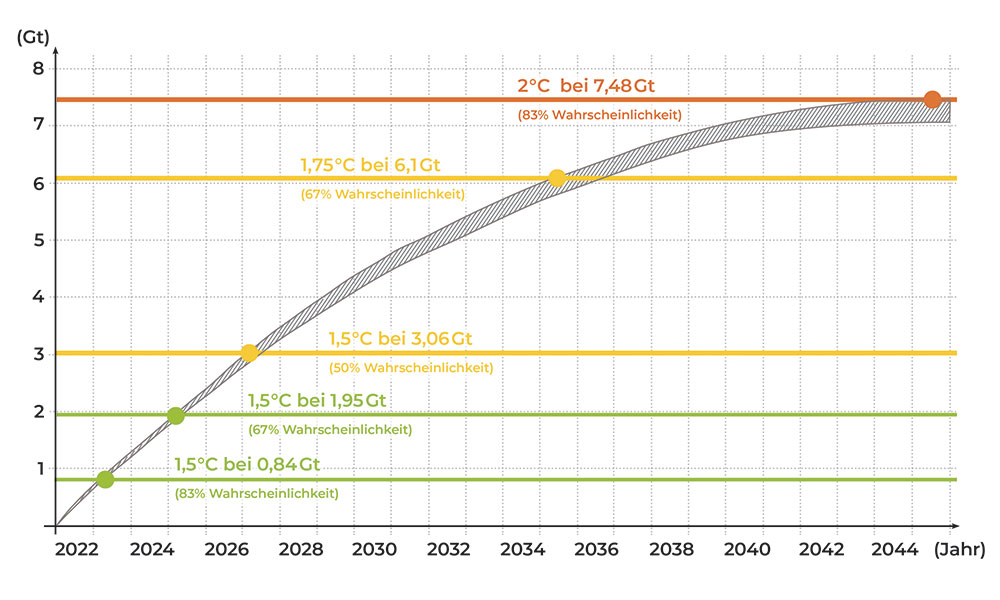
Figure 1: Future German CO2 emissions according to the Climate Protection Act compared with the remaining CO2 budgets for various climate targets (according to budget calculations from 2016 onwards). The hatched area represents the uncertainty resulting from the potentially different development of CO2 and non-CO2 emissions (the Climate Protection Act specifies total greenhouse gas emissions). [1] Values corrected after consultation with the German Advisory Council on the Environment.
Calculation since 1990: Germany's Paris budgets have long been exhausted
In our new calculation, we now make a comparison: What actually happens to the budgets if we at least include climate debt since 1990? 1990 is the reference year agreed upon at the beginning of the UN climate process. This, of course, also ignores over a century of industrialization. Nevertheless, the result is very clear: According to this calculation, the German budgets for 1,5°C were already used up around 2010. In the 2010s, 1,7°C and 1,8°C also became unattainable – the last targets that can still be described as compatible with the Paris Agreement. The chance of achieving 2°C is also rapidly dwindling: This year, the budget for a 67% chance of meeting this limit will be used up, and in 2027, the budget for a mere 50% chance will be used up. If we were to calculate back a few years further, i.e., include even more climate debt, these targets would of course also have been missed long ago.
| Climate target | Budget 1990 (Gt CO2) | Consumed in the year… | Remaining budget January 1, 2022 (Gt CO2) |
| 1,5 °C (83%) | 16,67 14,94 (old) | 2008 2005 (old) | -10,34 -12,64 (old) |
| 1,5 °C (67%) | 17,93 16,21 (old) | 2009 2007 (old) | -9,07 -11,37 (old) |
| 1,5 °C (50%) | 19,2 17,48 (old) | 2011 2008 (old) | -7,8 -10,10 (old) |
| 1,7 °C (67%) | 21,74 20,02 (old) | 2014 2012 (old) | -5,26 -7,56 (old) |
| 1,8 °C (67%) | 23,65 21,93 (old) | 2017 2014 (old) | -3,35 -5,66 (old) |
| 2 ° C (67%) | 27,45 25,74 (old) | 2022 2019 (old) | 0,46 -1,85 (old) |
| 2 ° C (50%) | 30 28,28 (old) | 2027* 2023 (old) | 3 0,69 (old) |
* according to the Climate Protection Act
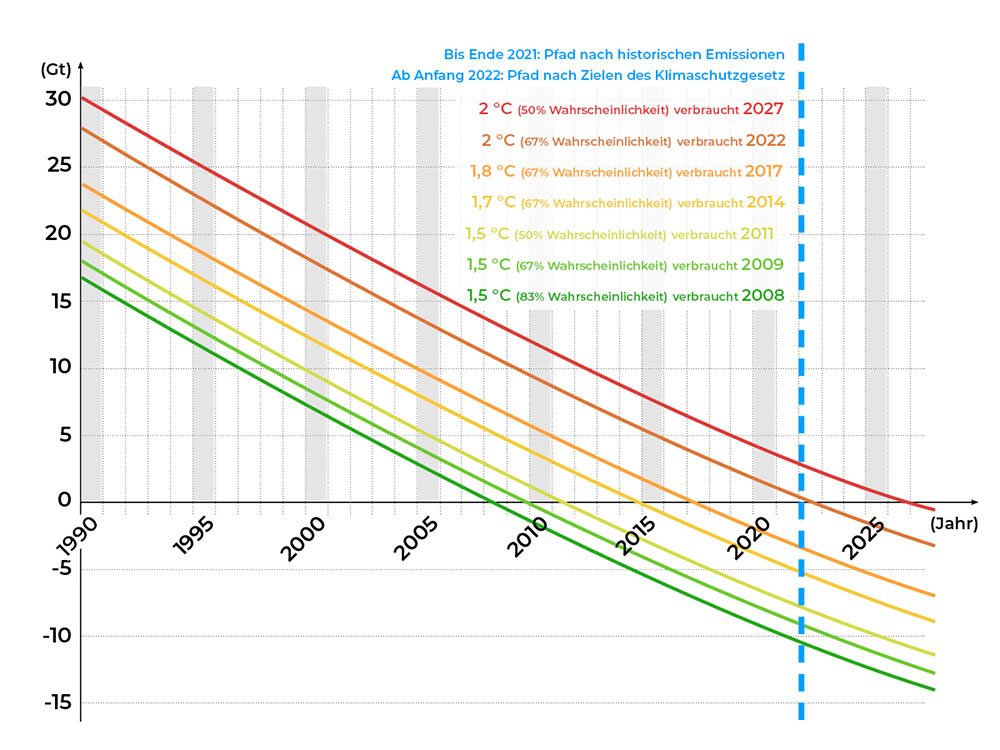
Figure 2: Historical development of the German CO2 budget since 1990 according to various climate targets. The calculation is based on current IPCC budgets. Global emissions since 1990 were added to these, and the resulting budgets for 1990 were then divided equally among the world population.
Climate debt – how to pay it off?
The figures reveal that it will no longer be possible to simply "pay off" accumulated climate debts in the future through above-average, consistent climate protection. Too much damage has already been done. This makes it all the more important to enforce global climate justice in various policy areas: Financial support for adaptation measures in countries particularly affected by the climate crisis by countries like Germany must significantly increase. Likewise, climate-friendly technologies must be made available in poorer countries – in the spirit of self-determined development that is not hampered by intellectual property rights in the hands of European and North American corporations. International trade relations must become fairer overall, instead of perpetuating unequal power relations through ever new free trade agreements. The global South must not be treated merely as a repository of raw materials for climate technologies while the profits flow to the North. Safe escape routes must also be created for people forced to leave their homeland due to the direct and indirect impacts of the climate crisis – including armed conflicts.
These are just some of the most obvious dimensions. Consistent climate protection in Germany must, of course, also take place – its further postponement must not simply be "offset" against support for more or less questionable climate protection projects in the global South, as is the case in some international compensation mechanisms.
Budgets and climate debt: always political!
The comparison shows why climate debt is such a taboo in political debate: It's a bottomless pit, so to speak. The charts also illustrate why budgets and reference years are fundamentally so controversial in international climate policy: Depending on which past emissions are included, the calculations shift dramatically. There are no "objectively" correct solutions. Budgets are always political!
This also applies to the principle of equal per capita distribution we use. Countries with historically high emissions, i.e., large climate debts, usually prefer a target formulation in which they reduce their emissions by a certain percentage starting from their high level – thus elegantly circumventing the issue of climate debt. The question of how population growth is taken into account is also highly political. Our calculation adjusts the per capita emissions budgets to population growth in order to avoid penalizing people for population growth in their country under climate policy. (Since a country's relative share of the world population changes over time, we used the average value since 1990. The German share fell from 1,5% to 1,07% between 1990 and 2020; the average was 1,27%. [5])
Finally, a note on the context of these figures: Even if the budget figures appear very precise when broken down into individual countries and years, it should be borne in mind that the underlying global total budgets, which the Intergovernmental Panel on Climate Change (IPCC) provides in rough increments of 50 gigatons, are subject to uncertainty. Furthermore, they only include direct CO2 emissions from the combustion of fossil fuels, which can be clearly allocated to specific territories. They do not include other greenhouse gases such as methane (MH4) and nitrous oxide (N2O), which would need to be reduced in parallel. Emissions from land-use changes, such as deforestation, are also not included, nor are CO2 emissions from international aviation. Despite these limitations, the budgets are helpful benchmarks that show the climate target trajectory we are actually on—and how much climate injustice still needs to be addressed. To achieve climate justice, however, we cannot stop at numbers; we must, above all, think qualitatively and reshape global social relationships.
Correction and addition (June 2022)
After the publication of this article, our exchange with researchers regarding the budget calculations continued. We were made aware of an inconsistency in our figures, some of which had already been included in the SRU's calculations.[6] After consultation with the SRU, we have therefore updated our presentation. It now includes the most recent figures and has, in a sense, been scientifically reviewed several times. We would like to thank Andrea Bues and Wolfgang Lucht (both SRU) as well as Mirko Schäfer (INATECH University of Freiburg) for their joint efforts to clarify this complex situation.
What does this mean? The remaining German CO2 budget (according to the German Advisory Council on the Environment's (SRU) method) has increased slightly due to the recalculation – by about 300 megatons, which is slightly less than half a year's German emissions.[7] However, it remains the case that all 1,5 °C budget thresholds for Germany would be exceeded in the coming years according to the Climate Protection Act's trajectory, calculated from 2016 onwards (SRU method), only a few months later than previously calculated. The shift has a correspondingly greater effect in the climate debt method from 1990 onwards (the starting budget in 1990 was thus 1,72 Gt higher, the remaining one today 2,3 Gt higher). Nevertheless, all budgets for 1,5 °C, 1,7 °C, and 1,8 °C have still been exhausted. Germany's remaining budget for the 2 °C target would be exceeded this year or in 2027 (with a 67% and 50% probability, respectively).
As an interesting new publication on the topic, we recommend the German Advisory Council on the Environment's (SRU) statement on the German CO2 budget, published in June. This statement repeatedly refers to the work of the concept paper and includes the revised figure shown above. The statement goes into great detail about the calculation of the budget and the various criteria by which it can be considered very generous for Germany. It also contains a comprehensive critique of the widespread notion that the budgets can be overstretched by offsetting future negative emissions: the large-scale applicability of the various technologies currently under development for this purpose is too uncertain.
Fortunately, the SRU even calculates, for the first time, a German residual CO2 budget for the 1,5°C target with a 2/3 probability of target achievement (2 Gt from 2022). Compliance with this budget level, which we had already included in our previous calculations, was previously considered too unrealistic to even include the figure. However, the figure was omitted from the press release accompanying the publication. Accordingly, the budget figure for a 50% chance of 1,5°C (3,1 Gt CO2) generally appeared in the headlines as "the" German 1,5°C residual budget. From a real-political perspective, compliance with this target would already be an impressive success from today's perspective – but as a German contribution to 1,5°C, it would remain very shaky.
[1] We are referring to the 2021 Climate Protection Act. While it does not specify long-term budget figures, it does specify annual reduction targets for greenhouse gas emissions (a reduction by a certain percentage compared to 1990). Climate neutrality is to be achieved by 2045. The Climate Protection Act does not specify precise targets for the years after 2040; here we assume a uniform reduction from 2040 (-88% compared to 1990) to 2045. (Climate neutrality itself is a controversial concept, as it includes the possibility of offsetting remaining emissions to a "net zero" using so-called negative emission technologies. To what extent this will be reliably possible is unclear.) Things are somewhat complicated by the fact that the figures in the Climate Protection Act refer to total greenhouse gas emissions, but global budget calculations are usually only made for CO2. CO2 accounts for about 88% of German greenhouse gas emissions. The Climate Protection Act provides specific reduction paths only for economic sectors, not for individual greenhouse gases. With a uniform reduction across all sectors and for all greenhouse gases, the targets under the Climate Protection Act would result in a budget of 7,46 Gt CO2. However, the sectoral targets set for 2030 envisage a significantly slower reduction in emissions in agriculture, where a significant portion of all non-CO2 emissions occur. The energy sector, in which CO2 is heavily predominant, is expected to reduce emissions by an above-average amount. We therefore assume that the overall CO2 budget will be somewhat lower (approximately 7–7,4 Gt). Territorial emissions are calculated in each case, meaning that the decisive factor is where the CO2 emissions occur, not where the manufactured and transported goods are consumed. Some wealthier countries import more emissions from consumer goods overall than they export and thus perform better in territorial balances. In Germany, however, the balance is relatively balanced due to its export-oriented economy.
[2] The latest figures were provided by the IPCC in autumn 2021 in its sixth World Climate Report (AR 6). The budget table is located on page 63 of the Technical Summary (TS-63), p. 106 in the PDF document of the full report.
[3] In the pre-coronavirus year of 2019, per capita CO2 emissions in Germany were 8,56 tonnes, compared to 4,78 tonnes worldwide. In 2000, the disparity was even greater: 10,95 tonnes in Germany, compared to 4,13 tonnes worldwide. Emissions figures according to Global Carbon Atlas, population data according to World bank
[4] The methodology is explained by the Council of Experts in the “Environmental report 2020“ on pp. 51–53
[5] Population figures are from the World bank
[6] We had mistakenly assumed that the IPCC's global CO2 budgets excluded the highly uncertain emissions from land use changes (LULUCF - land use, land-use change and forestry), and accordingly also used the historical emission figures for Germany and the world without LULUCF. In fact, however, the IPCC budgets include the even broader category AFOLU (agriculture, forestry and land use). The IPCC's global budget figures are therefore not exactly comparable with the national emission calculations (and the summed global figures), which usually show LULUCF. Nevertheless, the distortion is smaller if LULUCF emissions are included in the comparative calculation. The German Advisory Council on the Environment (SRU), as the most important source for calculations of the German CO2 budget, had not previously included these figures at the German level (although it does at the global level), but has done so since its most recent publication.
[7] In Germany, annual LULUCF emissions have mostly been slightly negative for decades, which has a positive impact on the budget.