We environmental organizations are sounding the alarm! Reclaiming the coalfields will cost billions. We fear that energy companies will pass these costs on to the public while keeping profits from renewables for themselves.
On the occasion of the state elections in the still lignite-producing states of Saxony and Brandenburg in September, an important future issue for both states deserves increased attention: the plans and costs for the re-use of the lignite mining areas.
As civil society and environmental organizations in the affected countries, we consider the current precautionary policies to be opaque, ecologically risky, and potentially financially inadequate. We therefore call for a comprehensive change of course toward a transparent and ecologically sustainable precautionary policy. This must ensure that mining companies cannot evade their financial responsibility.
Open-cast mining today, water crisis tomorrow?
Environmental protection, especially water conservation, requires careful remediation of the former open-cast mines, which entails high costs and considerable risks, particularly for the drinking water supply. The remediation work will continue for many decades after the coal industry has ended. According to the Federal Mining Act, the mining companies are responsible for planning, implementing, and financing the measures.
The climate crisis will massively exacerbate the existing water shortage in the coal-mining regions. In light of this, the mining companies' strategy of creating open-cast mine lakes for the remaining mines must be re-examined. In addition to ecological risks and a compromised drinking water supply, this also threatens significant additional costs compared to previously planned scenarios. Temporary solutions such as the proposed Elbe-Spree diverter cannot resolve the water shortage, but only shift it. We demand balanced re-use concepts that ensure environmental and water protection! Regional water strategies based on independent expert reports are also needed for the coal-mining regions. To this end, the coal companies must make their relevant data available in full.
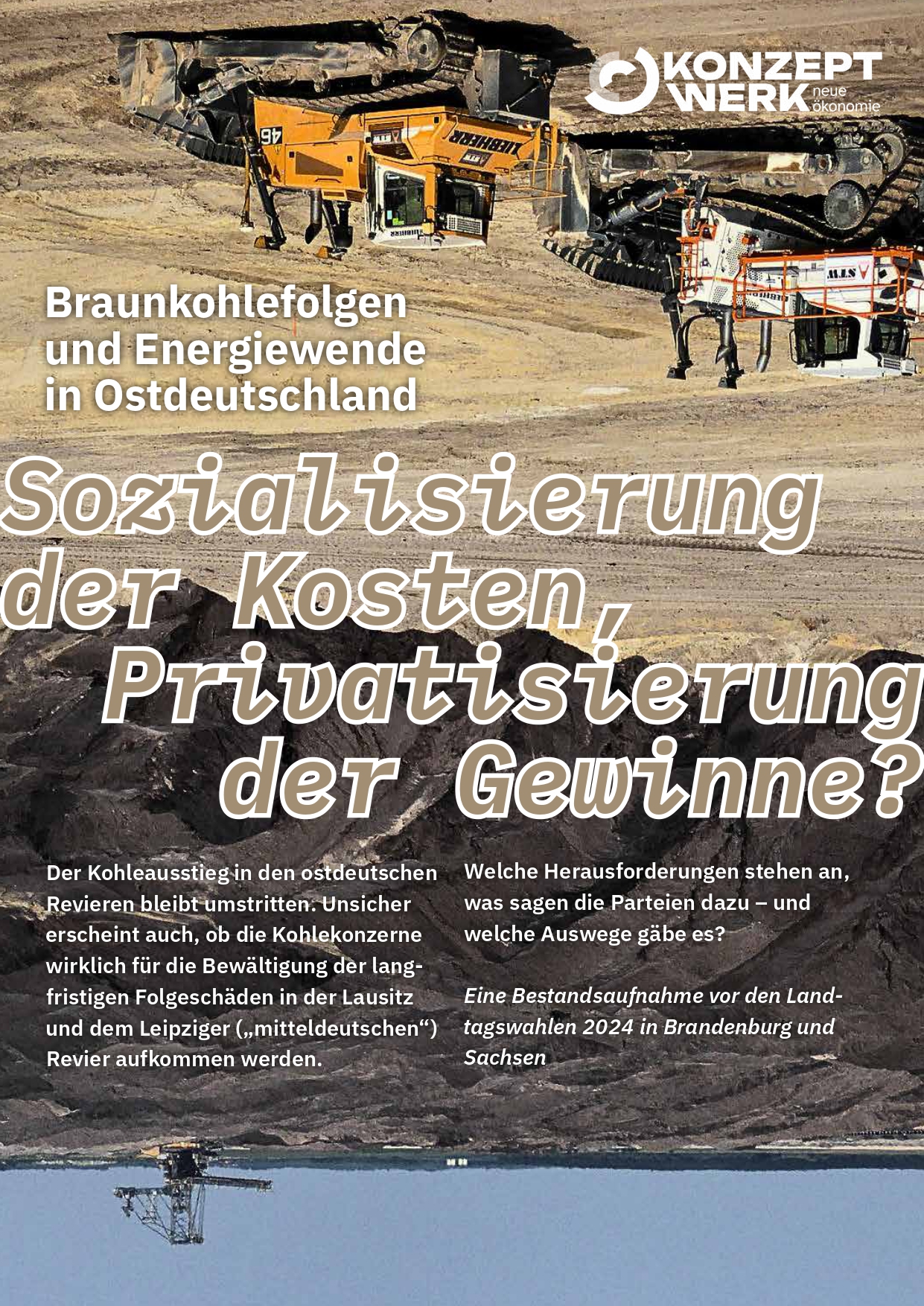
Consequences of lignite and the energy transition in East Germany
Socialization of costs, privatization of profits
Who will pay the follow-up costs of lignite mining? This question is coming back into focus in the run-up to the 2024 state elections in Saxony and Brandenburg. We asked the relevant democratic parties for their positions and hereby publish their answers.
Opencast mining follow-up costs: safety and transparency deficiencies
While the state governments have initiated precautionary measures by establishing precautionary companies during the current legislative period, there is a lack of transparency regarding the agreements and the impact of current restructuring efforts by LEAG and MIBRAG. We have serious doubts about the governments' claims that the current precautionary concepts are sufficient. Should the responsible companies become insolvent, the states would have to bear the costs. Since a significant portion of the subsequent costs is already being paid from public funds through the federal government's coal phase-out compensation, it is all the more important to ensure the companies' effective liability for the remaining costs.
LEAG recently announced the spin-off of its future-oriented business units, such as its renewable energy divisions. There are concerns that this will isolate the coal business in a kind of "bad bank" to avoid future liability claims for follow-up costs from open-cast mining. We have been observing a similar development for some time at MIBRAG, which is also spinning off the business areas in which future profits are expected. The coal business, on the other hand, will foreseeably generate increasingly less income in the coming years, which, however, would finance the agreed payments to the pension companies. In the event of insolvency, the liability of the parent company EPH for the liabilities of LEAG and MIBRAG would not be guaranteed, based on current knowledge. The companies' balance sheet provisions therefore appear uncertain. The business models of the additional pension companies created are, in turn, not comprehensible to the public.
Costs for the public, profits for corporations – or democratic control?
The new governments must avert a scenario in which the ecological costs associated with the coal legacy are passed on to the public, while energy companies can simultaneously privatize the profits associated with the energy transition. Instead, it must be ensured that the revenues from these new business areas initially secure the financing of legacy pollution management. To this end, options for transferring the sites to public ownership with strong democratic oversight functions must also be examined. This would also facilitate sustainable recultivation planning that can meet the needs of the population, especially in light of the water crisis.
This could also expand the scope for vibrant, democratic structural change in the regions. The remaining residents of Pödelwitz, which has been saved, want to become a model village of ecological and social sustainability. To make this possible and revitalize the town, the local association "Pödelwitz has a Future" and other initiatives are calling for MIBRAG's vacant properties to be transferred into public ownership. This is the only way to advance village development independently of the company's opaque strategies, which so far have not presented their own ideas but have only attempted to thwart the association's visions. Such initiatives from the coal-mining regions deserve support from civil society and politics.
For transparency and secure financing of the follow-up costs of lignite
The future state governments must finally create transparency regarding the pension agreements with LEAG and MIBRAG, including the savings concepts, investment guidelines, and pledging agreements for the pension companies. The details of the underlying cost calculations for the long-term recultivation measures necessary for a socially and ecologically viable region must also be made publicly transparent. Lack of transparency undermines trust in political processes and fuels doubts about the measures taken so far.
We call on the parties in Saxony and Brandenburg to take a clear position on the issues of ecological lignite remediation, water strategies, and the subsequent costs of lignite mining.
Joint statement by:
• Konzeptwerk Neue Ökonomie
• Greenpeace Germany
• Greenpeace local groups Leipzig-Halle, Chemnitz, Cottbus & Upper Lusatia
• BUNDjugend
• BUNDjugend Brandenburg
• BUND Saxony
• BUND Brandenburg
• Pödelwitz has a future
• Green League
• Communia
• Citizens' initiative "Future instead of brown coal Lützen"
• Youth Forum for Sustainability Brandenburg
• Nature Friends Youth Brandenburg
• Nature Friends Brandenburg