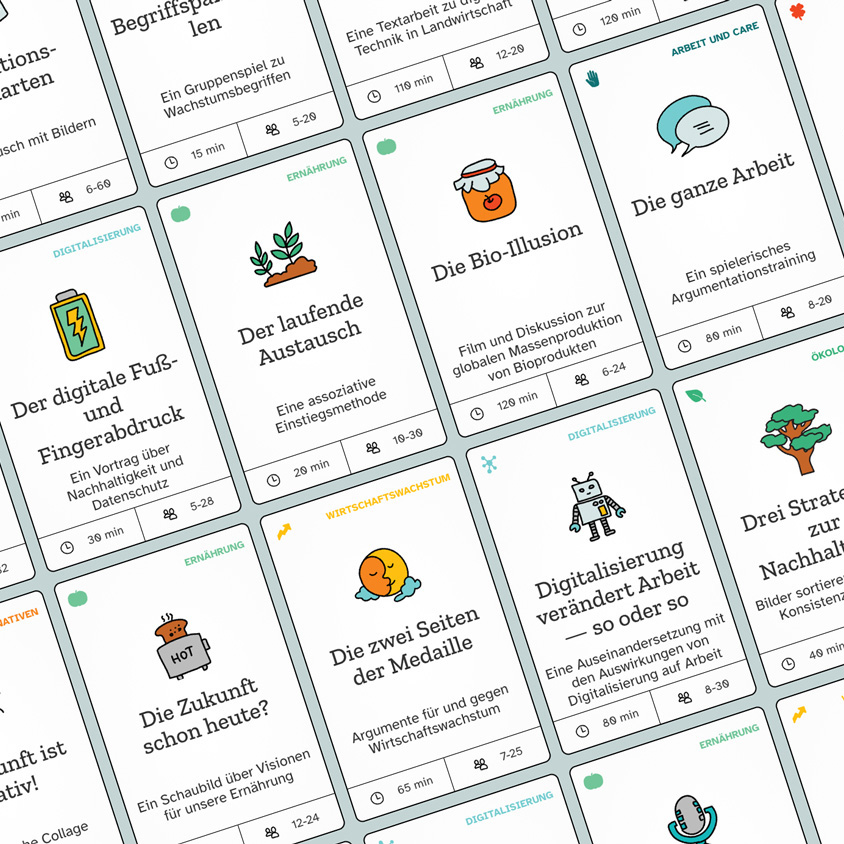
Social inequalities, the climate crisis, and other worsening crises make these times extremely challenging—especially for teachers and educators. With our methods platform, we want to provide you with tools and ideas to explore the complexity of our world in learning spaces and counteract feelings of hopelessness and powerlessness! Our methods particularly support people aged 15 and over in better understanding global, societal, political, economic, and socio-ecological contexts. They facilitate critical analysis, the formation of one's own opinions, and point out perspectives for action, entirely in the spirit of Education for Sustainable Development (ESD). The focus of the methods places great emphasis on a critical attitude toward power, builds on the concept of transformative education, and engages the mind, heart, and hand.
Our understanding of education
Through our educational work, we aim to create learning spaces filled with the diverse perspectives, experiences, emotions, thoughts, and desires of the participants. In this way, we want to support people in finding answers together to pressing questions. It is important to us to cultivate an open , empathetic , and critically reflective approach to one another. By this, we mean recognizing, highlighting, and dismantling power hierarchies.
Together with the participants of our events, we embark on a search for the building blocks for a different economy, the causes of social injustice and ecological crises. We question common assumptions and discuss what constitutes a good life. We learn about proven alternatives and create learning spaces to make socio-ecological economics directly tangible. The following applies: There are no simple answers. The problems we face are complex, and the solutions needed are equally complex. We understand socio-ecological transformation as an open process. To achieve this, we want to empower people in their self-efficacy, mindfulness, and solidarity.
Our transformative education methods embrace learning with head, heart, and hands. This means that our methods go beyond imparting knowledge; they address our own embeddedness in global power relations and also address the emotional level. Together, we examine our economic system, the causes of social injustice, and ecological crises. We research, reflect, and discuss, listen to each other and our bodies, share our concerns, take action, and actively shape society.