Cookies?

Wir würden Deinen Besuch gern in unsere Statistik aufnehmen. Du bleibst anonym und es wird kein Profil erstellt. Wenn Du ablehnst, beschränken wir uns auf das Abspeichern von Cookies und Daten, die unvermeidlich für das Funktionieren der Seite sind.

From Climate Justice to Climate Reparations

About the discourse of climate depts and reparations

In this article, we provide an insight into how and why the climate crisis is unjust in the context of the Global North and the Global South, throw light on the discourse of climate debt and reparations, and briefly introduce our planned work on the topic going forward in the next one and half years.

At Konzeptwerk Neue Ökonomie, we are engaged in topics relating to the social and ecological transformation of our economy and addressing questions of global justice. We highlight many paths that can lead to a far-reaching transformation of our society. In our project „Building Blocks for Climate Justice. Transformative. Solidaric. Feasible“ (Bausteine für Klimagerechtigkeit. Transformativ. Solidarisch. Machbar) we looked at measures that are particularly effective from a climate justice perspective for a socio-ecological transformation in the next 5-10 years. Within this framework, we are also working on the issue of climate debt and want to make demands for reparations more visible and the movements for it stronger.

Who is responsible for the Climate Crisis?

As the world continues to heat up at alarming and irreversible levels, it is fuelling environmental degradation, natural disasters, weather extremes, food and water insecurity, economic disruption and growing inequalities. Climate change is an indisputable reality and the climate crisis is a global phenomenon threatening not just human lives, but also the ecosystem and non-human lives all over the world. What just recently became noticeable in the industrial countries has been a harsh reality for many parts of the world for a long time. The climate crisis does not effect everyone equally; it is highly unjust especially between the Global North and the Global South. Those who are responsible for it are the least affected (vulnerable) and vice versa – those who are least responsible are the most affected.

The rich and industrialized countries in the Global North have historically borne the biggest responsibility for the climate crisis and continue to drive it today with overwhelmingly high consumption of energy and resources. A study from the year 2020 concludes that the Global North is collectively responsible for 92% of excess (everything above 350 ppm) greenhouse gas emissions while the Global South is only responsible for 8%. Germany ranks 4th on the list of historical emissions, although today only around 1% of the world’s population (84 million people) live here. Additionally, resource consumption in the Global North is approximately four times over the safe per capita boundary for the planet, while the Global South is significantly below its share of budget. Not to mention, a large share of the natural resources used in the Global North is actually is appropriated and comes from the Global South.

The Global South experience

As mentioned above, Global South countries, mostly former colonies, suffer the most from the consequences of the climate crisis. This is not only a result of the nature of global warming, but a consequence of the vulnerability of these countries. This vulnerability can be attributed to the fact that they benefited the least from the economic processes powering the climate crisis and therefore have less capacity and resources to adapt and respond, which in turn leads to the worsening of social and economic inequalities. Additionally, the odious debt of the South to the North is causing more inequality, extractivism, exploitation of natural resources, unequal exchange and economic dependence, preventing indebted countries from determining their own path of development. Therefore, the climate crisis is an issue of global justice and calls for collective action by not only looking to the future to mitigate its effects but also to the past to address the causes and repair the historic wrongs.

The root cause of the global climate crisis is inextricably linked to the expansion of capitalism and worldwide industrialisation based on fossil fuels, made only possible through colonial violence and oppression. Colonial powers and their companies violently and systematically dispossessed indigenous and marginalised populations from their lands and livelihoods to access, control and expropriate their land, soil, labour and resources, in the process establishing economic relationships with the colonies. Highly industrialised economies in Europe and the Global North emerged as a result of this appropriation and a global economy was created in which the needs of the centre determined the economic activities of the periphery. The spread of capitalism also brought about the need for competition and the constant pursuit of profit. Thus, countries in the Global South were restricted from promoting their own industries and kept in a position of subordination by being forced to “specialize” according to their own “competitive advantage”. Thereby, produce and export to meet the demands of the Global North.

From Colonialism to Neocolonialism

Such colonial and imperial patterns of plunder and domination continue even today, disregarding the livelihoods of the local populations and the ecological impact on their environment, as huge profits are channelled back from the Global South to the corporations and countries in the Global North. The extraction of resources such as coal, oil and gas to fuel the international energy system causes high levels of pollution and environmental hazards leading to the creation of “sacrifice zones” where the health and safety of local communities are compromised for economic gains and prosperity of the companies operating there.

Crippling debts, free trade agreements and structural adjustments limit the space and capacity of Global South countries to make sovereign decisions such as moving away from fossil fuels. Instead they are left at the mercy of the fossil fuel industry which is abetted to keep hold of resources and to continue harming the planet. Agribusiness is another example where the imperialist domination of the Global North is linked to climate change and environmental destruction in the Global South. An unsustainable and destructive agrarian model based on cash crop exports for international markets undermines food sovereignty for the local populations and leads to exhaustion of land and rare water resources.

Even in the case of decarbonization through green growth and green technology, happening mainly in the Global North, neocolonial practices are being reproduced. The Global North requires and relies on critical raw materials such as lithium, copper, cobalt and even (green) hydrogen available in the Global South, for example in Latin America and Africa, for their energy transition. The Global South is yet again viewed not just as a market for industrialized economies but also as providers of cheap natural resources and cheap labour so that the Global North can maintain and fuel it’s imperial way of living, characterised by high consumerism and excessive energy consumption. While the source of energy might have shifted from fossil fuels to renewable energies, the system is still founded on those structures of power imbalances and unjust development which caused dispossession, exploitation and injustices in the past.

On one hand, Global North governments, institutions and agencies formulate the rules of the green transition, ignoring questions of ownership, sovereignty and self sufficiency for the Global South, on the other hand Global North countries also possess the capital to build green infrastructure and exploit land and resources for their own environmental goals. Land grabbing for a green agenda can be witnessed in the dispossession of indigenous communities for conservation projects, in the appropriation of communal land for the production of biofuels and in the in the forced implementation of big solar and wind projects on agricultural land. While Global North governments present themselves as being environmental friendly and reducing carbon emissions within their own borders, they offer diplomatic support to multinational companies to continue extractive business practices in resource intensive Global South countries for the purpose of their own energy security.

This kind of extractivism goes hand in hand with ecological destruction, increase of social conflicts, high dependence on revenue from raw material export for extracting countries and high profits for transnational corporations, and the alteration of indigenous and alternative livelihoods in the Global South. Based on on endless economic growth, relations of power and dominance and the externalisation of social and ecological costs of production and distribution, the current global and unequal economic system is driving the ecological crisis. A just transition must first and foremost acknowledge the different responsibilities and vulnerabilities of the North and South. Simultaneously, the entire system needs to be restructured on principles of equality, democracy and respect for the rights of people in the Global South and their environment.

Climate Debt and Climate Reparations

The term „Climate debt“ refers to the fact that the early industrialized countries accumulated their wealth not only through slavery and colonial plunder, but also through the appropriation of natural resources – such as the atmosphere, into which CO2 has been emitted for centuries. This possibility is no longer feasible for countries of the Global South without exceeding all the tipping points of the climate system. Climate debt explicitly points to the case that countries, companies and communities that have contributed the most to the climate catastrophe have incurred an immense climate debt. Climate justice raises the urgent need to confront the historical responsibility of the Global North and the financial compensation from the perpetrators for historical CO2 emissions and its consequences on the Global South.

Since at least the 1990s, international movements for global justice have thematised the climate debt owed from the Global North to the Global South and demanded climate or ecological reparations for it to address the cause of the climate crisis and pay back for the harm inflicted. Climate reparations are strategies and actions taken by a state to redress past and present systemic injustices related to the climate crisis and to transform the (global) economy to ensure climate justice, well-being and equity for all people worldwide. Even though, it would not be possible to undo the damage done, reparations seek to mitigate consequences, prevent harm to future generations and create a fairer world. It is therefore crucial not only to question the financial debt of the Global South to the Global North, but also to emphasize the historical, climatic and ecological debt of the North to the Global South.

According to Maxine Burkett, there are three decisive elements to climate reparations. The first is an apology. The second is a financial compensation to give this apology actual or symbolic weight. The third, also the most urgent, is an obligation on the perpetrator not to repeat the offence, known as the “guarantee of non repetition.” In the sense of the climate emergency, this means not only taking full responsibility for all excess emissions but also a commitment to end the damage through rapid decarbonization and a systemic and structural transformation of the global economy. This includes ending the colonial and ongoing exploitation of people and the planet by the extractive economy and distributing power and resources more equitably.

Climate Reparations – What is the current situation?

The most obvious actors demanding climate reparations are communities and organizations from the MAPA group, especially in the Global South, some of which also include governments. Under the broader framework of reparations, the Global South is also demanding for debt cancellation; a demand that is supported by trade unions, also mainly from the Global South. Besides debt cancellation, demands also include a just transition from fossil fuels and ending corporate impunity with legally binding international regulation that protects human rights and the environment and holds corporations accountable for their violations. While these demands have also been taken up to some extent by movements in the Global North, they are not yet at the centre of the current movement discourse.

Achieving climate reparations is a challenge. We believe it must start by influencing the public discourse. On the one hand, the issue of reparations must be at the heart of climate and global justice, a prerequisite for a healing process between the Global North and South and an important measure to stop further injustice and environmental destruction in the Global South. On the other hand, the topic is rarely discussed in Germany – outside of the climate negotiations – and only a few initiatives or NGOs are concerned with this issue. And when it is discussed, it is often in close connection with the UN process on loss and damage and to the exclusion of more far-reaching demands from the Global South. The loss and damage fund was agreed upon at COP27 as a mechanism to compensate “developing” countries cope with irreversible damage caused by global warming. However, it is different from the demand for reparations because it excludes the question of liability and compensation for past harms.

Additionally, the current political climate in Germany, raises the issue of how to address global justice objectives. The rise of right-wing movements and parties has shifted the debate on migration and progressive responsive focus on domestic redistribution at best. Conspiracy ideologues, ironically, frame global justice demands as an elite concern. Instead of withdrawing from global justice demands and the possibility of creating an internationalist perspective, there is a greater need to consider how demands for domestic and global economic justice can be reconciled as part of a broader shift away from productivist and extractivist imaginaries without reverting to mere idealism.

The Way Forward

Since 2023, we have been working on the topic of climate debt and reparations with a specific focus on Cameroon, due to Germany’s historical and colonial links to the country. We conducted an explorative workshop with civil society in Cameroon to discuss priorities and demands around climate debt and reparations. Going forward, we would like to continue transnational dialogue to advance our common understanding of climate reparations, develop and provide strategic orientation with and for civil society and activist groups and raise public awareness of historical climate debt and reparations. We plan to do so by preparing and publishing a case study on the topic in the context of Cameroon and Germany in cooperation with the Cameroonian organization Global Movement for Climate Justice (GMCJ), and by organizing strategy and communications workshops for scholars, civil society experts and activists in both countries, a series of public events, and by doing media work around the topics.

Within Germany, we would like to organize a workshop this year to address important strategic questions, discuss climate debt and reparations and build networks centred on the question of reparations. We would like to bring together perspectives from diverse backgrounds of actors, activist groups, NGOs. researchers and scholars working in various fields related to climate justice, anti racism and North-South justice/solidarity with the aim of formulating a roadmap while thinking about: How the demand for climate reparations can be strengthened in the broader public in Germany? How we (NGOs, movements, civil society) can work together to support actors already working on the topic? How can we centre voices of people, communities and movements in the Global South in climate action discourses here in the Global North?

We believe that the climate justice has to include climate reparation, as a learning field for practising decolonization, anti racism and for dealing with the colonial history of those affected by colonialism and the climate crisis through collective action and imagination. At the same time, we also consider it an imperative to create a field of international solidarity and global justice, and form appropriate alliances to fight global inequalities and injustices, challenge exploitative and neocolonial economic structures and develop an alternative, radical and transformative pathway that leads to a just and equitable future and a good life for all. The time is now to ask how can climate reparations be a reality? And how can climate reparations be a demand that is voiced, discussed, negotiated and implemented here in the Global North and especially in Germany?

Over the next year, we want to explore these questions and we hope to collaborate with inspiring individuals, groups and organizations. If you are interested in becoming part of this project, please feel free to contact us.

CO2-Budgets und Klimaschulden

Die historische Klimaschulden Deutschlands

Wenn wir historische Klimaschulden mit einberechnen, sind die deutschen CO2-Budgets für die Einhaltung der Pariser Klimaziele längst aufgebraucht. Die Emissionen müssen nicht nur schnellstmöglich sinken, sondern globale Klimagerechtigkeit muss auch auf anderen Wegen geschaffen werden. Hier bieten wir einen Überblick über verschiedene Budgetrechnungen und ihre Konsequenzen.

In unseren letzten Veröffentlichungen zu den Wahlprogrammen der Parteien und dem Koalitionsvertrag der Ampel-Regierung haben wir jeweils CO2-Budgetrechnungen aufgestellt. Diese Budgetrechnungen stellen die Mengen an CO2 dar, die nach den jeweils formulierten Klimazielen in Deutschland in den nächsten Jahrzehnten insgesamt noch ausgestoßen werden sollen. [1] Wir vergleichen diese Werte mit den laut Weltklimarat IPCC noch verbleibenden weltweiten Gesamtbudgets für die Erreichung verschiedener Temperaturgrenzen. Diese werden vom IPCC jeweils in verschiedenen Wahrscheinlichkeitsstufen berechnet. So ist das Budget, mit dem die 1,5 °C-Grenze mit einer Wahrscheinlichkeit von 83% eingehalten werden kann, deutlich kleiner als das Budget, innerhalb dessen die Grenze nur mit einer Wahrscheinlichkeit von 67% eingehalten wird. [2]

Die Budgets des IPCC verteilen wir dabei gleichmäßig auf die Weltbevölkerung, sodass für Deutschland ein Anteil von etwas mehr als 1% reserviert ist. Häufig wird bemerkt, dass diese Budgetrechnungen eine wichtige Dimension von Klimagerechtigkeit ignorieren: historische Klimaschulden. Denn bis heute emittiert Deutschland pro Kopf mehr als den weltweiten Durchschnittswert [3] – auf dieser Grundlage konnte seit über einem Jahrhundert hier großer materieller Reichtum produziert werden. So haben Deutschland und andere frühindustrialisierte Länder mit einem überschaubaren Anteil der Weltbevölkerung den Großteil der CO2-Speicherkapazitäten der Atmosphäre bereits für sich beansprucht. Würden andere Länder die gleiche Entwicklung nachholen, so würden alle Klimaziele verfehlt. Die Budgetrechnung zeigt damit neokoloniale Beziehungsmuster auf: Der globale Norden eignet sich die Erdatmosphäre an und profitiert davon auf Kosten des globalen Südens. Dort hat die Klimakrise zuerst dramatische Auswirkungen, obwohl die Menschen dort im Durchschnitt am wenigsten zum Problem beigetragen haben.

Deutschlands 1,5 °C-Budgets: Bald ist es zu spät

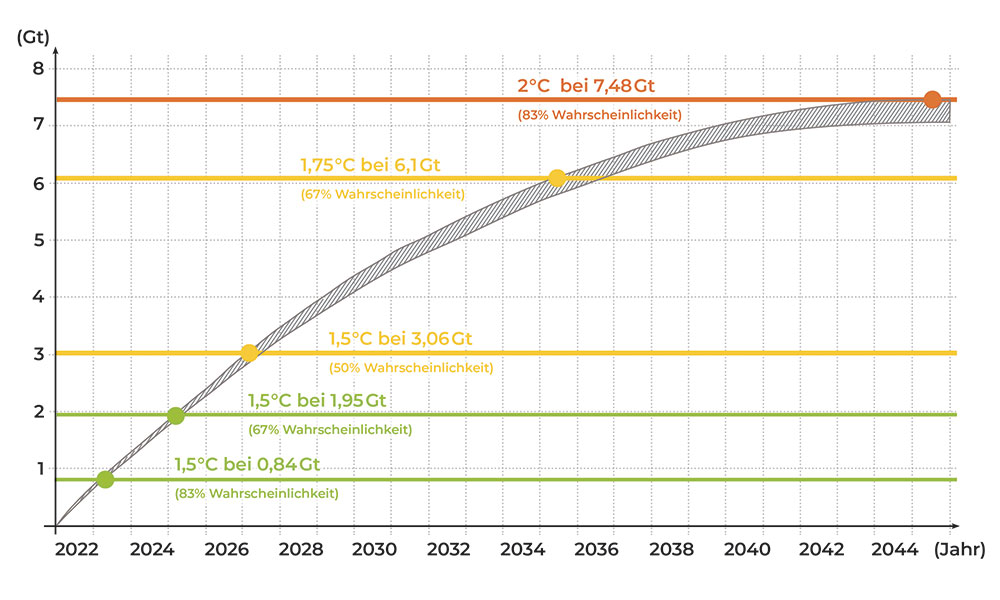
In unseren letzten Veröffentlichungen haben wir, basierend auf der Methodik des Sachverständigenrats für Umweltfragen der Bundesregierung [4], lediglich die Klimaschulden seit 2016 berücksichtigt: Das markiert den Zeitpunkt nach Unterzeichnung des Pariser Klimavertrags. Spätestens hier, so das Argument, haben sich fast alle Staaten dazu bekannt, die Erderhitzung „möglichst“ auf 1,5 °C, aber mindestens auf „deutlich unter“ 2 °C zu begrenzen. Daran müssen sie sich messen lassen. Nach dieser (jetzt aktualisierten) Rechnung werden die deutschen Budgets für 1,5 °C – mit den unterschiedlichen Wahrscheinlichkeitsstufen der Erreichung dieses Ziels – in den nächsten fünf Jahren aufgebraucht sein. Bei Einhaltung des Klimaschutzgesetzes würde Deutschland mehr als doppelt so viel emittieren als maximal zulässig wäre, um auch nur eine 50%-Chance auf 1,5 °C zu gewährleisten (7-7,4 Gt statt ca. 3,1 Gt CO2). Auch das Budget für eine 67%-Chance auf 1,75 °C (6,1 Gt) würde so überschritten. Für 2°C wäre es voraussichtlich ausreichend, die Emissionen bis etwa 2040 auf Null zu senken. Die offiziellen Vorgaben des deutschen Klimaschutzgesetzes kommen dem zwar zumindest nahe, doch aktuell ist angesichts der zögerlichen staatlichen Maßnahmen sehr fraglich, ob der dort vorgesehene Pfad wirklich eingehalten werden kann.

Infografik zu den deutschen Klimazielen und CO2-Budgets

Abbildung 1: Zukünftige deutsche CO2-Emissionen nach Klimaschutzgesetz verglichen mit den verbleibenden CO2-Budgets für verschiedene Klimaziele (nach Budgetrechnung ab 2016). Der schraffierte Bereich stellt die Unsicherheit da, die sich aus der potentiell unterschiedlichen Entwicklung der CO2- und Non-CO2-Emissionen ergibt (Klimaschutzgesetz gibt gesamte Treibhausgasemissionen vor). [1] Werte korrigiert nach Verständigung mit dem Sachverständigenrat für Umweltfragen.

Rechnung seit 1990: Die deutschen Paris-Budgets sind längst aufgebraucht

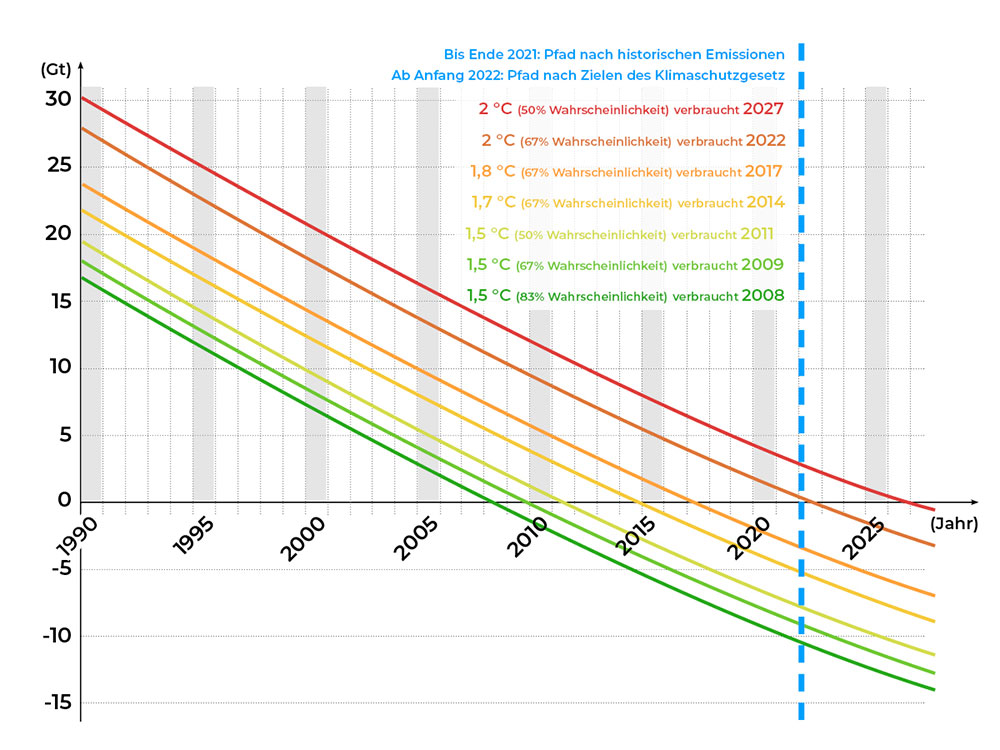
In unserer neuen Berechnung machen wir nun einen Vergleich auf: Was passiert eigentlich mit den Budgets, wenn wir wenigstens die Klimaschulden seit 1990 einberechnen? 1990 ist das Vergleichsjahr, auf das sich am Anfang des UN-Klimaprozesses verständigt wurde. Auch das blendet natürlich bereits über ein Jahrhundert Industrialisierung aus. Dennoch ist das Ergebnis sehr deutlich: Nach dieser Berechnung wurden die deutschen Budgets für 1,5 °C bereits um 2010 verbraucht. In den 2010ern wurden auch die 1,7 °C und 1,8 °C unerreichbar – also die letzten Ziele, die sich noch als kompatibel mit dem Pariser Vertrag bezeichnen lassen. Auch die Chance auf 2 °C schwindet momentan rapide: In diesem Jahr wird das Budget für eine 67%-ige Chance auf die Einhaltung dieser Grenze verbraucht sein, 2027 dann auch das für eine bloß 50%-ige Chance. Würden wir noch einige Jahre weiter zurückrechnen, also noch mehr Klimaschulden einbeziehen, wären natürlich auch diese Ziele längst verpasst.

KlimazielBudget 1990
(Gt CO2)
Verbraucht im Jahr…Restbudget 1. Januar 2022
(Gt CO2)
1,5 °C (83%)16,67
14,94 (alt)
2008
2005 (alt)
-10,34
-12,64 (alt)
1,5 °C (67%)17,93
16,21 (alt)
2009
2007 (alt)
-9,07
-11,37 (alt)
1,5 °C (50%)19,2
17,48 (alt)
2011
2008 (alt)
-7,8
-10,10 (alt)
1,7 °C (67%)21,74
20,02 (alt)
2014
2012 (alt)
-5,26
-7,56 (alt)
1,8 °C (67%)23,65
21,93 (alt)
2017
2014 (alt)
-3,35
-5,66 (alt)
2 °C
(67%)
27,45
25,74 (alt)
2022
2019 (alt)
0,46
-1,85 (alt)
2 °C
(50%)
30
28,28 (alt)
2027*
2023 (alt)
3
0,69 (alt)

* gemäß Pfad nach Klimaschutzgesetz

Infografik zu den historischen Klimaschulden und den CO2-Budgets seit 1990

Abbildung 2: Historische Entwicklung des deutschen CO2-Budgets seit 1990 nach verschiedenen Klimazielen. Berechnung bezieht sich auf aktuelle IPCC-Budgets. Zu diesen wurden die weltweiten Emissionen seit 1990 addiert und die so errechneten Budgets für 1990 gleichmäßig auf die Weltbevölkerung aufgeteilt.

Klimaschulden – wie begleichen?

Die Zahlen legen offen, dass es nicht mehr möglich sein wird, angehäufte Klimaschulden einfach nur durch überdurchschnittlich konsequenten Klimaschutz in der Zukunft zu „begleichen“. Zu viel Schaden wurde bereits angerichtet. Umso wichtiger wird es jetzt, globale Klimagerechtigkeit in verschiedenen Politikbereichen durchzusetzen: Die finanzielle Unterstützung für Anpassungsmaßnahmen in besonders von der Klimakrise betroffenen Ländern durch Staaten wie Deutschland muss deutlich steigen. Ebenso müssen klimafreundliche Technologien in ärmeren Ländern verfügbar gemacht werden – und zwar im Sinne einer selbstbestimmten Entwicklung, die nicht durch geistige Eigentumsrechte in den Händen europäischer und nordamerikanischer Konzerne erschwert wird. Internationale Handelsbeziehungen müssen insgesamt gerechter werden, statt die ungleichen Machtverhältnisse über immer neue Freihandelsverträge fortzuschreiben. Der globale Süden darf dabei nicht nur als Rohstofflager für Klimatechnologien behandelt werden, während die Profite in den Norden abfließen. Auch müssen sichere Fluchtwege für Menschen geschaffen werden, die durch die direkten und indirekten Auswirkungen der Klimakrise – etwa auch durch bewaffnete Konflikte – gezwungen sehen, ihre Heimat zu verlassen.

Das sind nur einige der offensichtlichsten Dimensionen. Konsequenter Klimaschutz in Deutschland muss natürlich zusätzlich passieren – seine weitere Aufschiebung darf nicht wie in manchen internationalen Ausgleichsmechanismen vorgesehen einfach gegen die Unterstützung von mehr oder weniger fragwürdigen Klimaschutzprojekten im globalen Süden „verrechnet“ werden.

Budgets und Klimaschulden: immer politisch!

Der Vergleich zeigt, warum Klimaschulden ein solches Tabu in der politischen Diskussion sind: Sie sind sozusagen ein Fass ohne Boden. Die Grafiken veranschaulichen gleichzeitig, warum Budgets und Referenzjahre in der internationalen Klimapolitik grundsätzlich so umstritten sind: Je nachdem, welche vergangenen Emissionen einbezogen werden, verschieben sich die Rechnungen dramatisch. „Objektiv“ richtige Lösungen gibt es nicht. Budgets sind immer politisch!

Das gilt auch für das von uns verwendete Prinzip der gleichmäßigen Pro-Kopf-Verteilung. Länder mit historisch hohen Emissionen, also großen Klimaschulden, bevorzugen stattdessen meistens eine Zielformulierung, bei der sie ihre Emissionen ausgehend von ihrem hohen Niveau um einen bestimmten Prozentsatz senken – und umschiffen so elegant die Frage der Klimaschulden. Auch die Frage, wie die Bevölkerungsentwicklung berücksichtigt wird, ist hochpolitisch. Unsere Berechnung passt die pro Kopf verteilten Emissionsbudgets an die Bevölkerungsentwicklung an, um Menschen nicht für Bevölkerungswachstum in ihrem Land klimapolitisch zu bestrafen. (Da sich der relative Bevölkerungsanteil eines Landes an der Weltbevölkerung mit der Zeit verändert, haben wir den Durchschnittswert seit 1990 zugrunde gelegt. Der deutsche Anteil ist dabei zwischen 1990 und 2020 von 1,5% auf 1,07% gesunken; im Durchschnitt betrug er 1,27%. [5])

Abschließend noch ein Hinweis zur Einordnung dieser Zahlen: Auch wenn die Budgetangaben auf einzelne Länder und Jahre heruntergebrochen sehr exakt wirken, ist zu bedenken, dass die zu Grunde liegenden globalen Gesamtbudgets, die der Weltklimarat in groben Schritten von 50 Gigatonnen angibt, mit Unsicherheiten behaftet sind. Sie enthalten zudem nur direkte CO2-Emissionen aus der Verbrennung fossiler Brennstoffe, die klar territorial zuordbar sind. Nicht einberechnet sind andere Treibhausgase wie Methan (MH4) und Distickstoffmonoxid (N2O), die parallel reduziert werden müssten. Auch Emissionen aus veränderter Landnutzung, z.B. Waldrodungen, sind nicht enthalten, ebenso wie CO2 aus dem internationalen Flugverkehr. Trotz dieser Einschränkungen sind die Budgets hilfreiche Orientierungsmarken, die zeigen, auf welchem Klima-Zielkurs wir uns eigentlich befinden – und wie viel Klima-Ungerechtigkeit es aufzuarbeiten gibt. Für Klimagerechtigkeit dürfen wir aber nicht bei Zahlen stehenbleiben, sondern müssen vor allem qualitativ denken und globale soziale Beziehungen anders gestalten.

Korrektur und Ergänzung (Juni 2022)

Nach Erscheinen dieses Beitrags setzte sich unser Austausch mit Wissenschaftler*innen über die Budgetberechnungen fort. Wir wurden dabei auf eine Ungereimtheit in unseren Zahlen aufmerksam gemacht, die teilweise bereits in den Berechnungen des SRU enthalten war.[6] Nach Verständigung mit dem SRU haben wir daher unsere Darstellung noch einmal aktualisiert. Sie beinhaltet jetzt die neuesten Zahlen und ist gewissermaßen mehrfach wissenschaftlich geprüft. Wir bedanken uns bei Andrea Bues und Wolfgang Lucht (beide SRU) sowie Mirko Schäfer (INATECH Uni Freiburg) für die gemeinsamen Anstrengungen zur Aufklärung der komplizierten Sachlage.

Was bedeutet das? Das verbleibende deutsche CO2-Budget (nach SRU-Methode) ist durch die Neuberechnung geringfügig angewachsen – um etwa 300 Megatonnen, also etwas weniger als die deutschen Emissionen eines halben Jahres.[7] Nach wie vor gilt aber: Alle 1,5 °C-Budgetmarken für Deutschland würden nach dem Pfad des Klimaschutzgesetzes bei Berechnung ab 2016 (SRU-Methode) in den nächsten Jahren überschritten, nur jeweils einige Monate später als bisher kalkuliert. In der Klimaschulden-Methode ab 1990 wirkt sich die Verschiebung entsprechend stärker aus (das Startbudget 1990 war somit um 1,72 Gt höher, das heute verbleibende um 2,3 Gt). Dennoch sind nach wie vor alle Budgets für 1,5 °C, 1,7 °C und 1,8 °C verbraucht. Das deutsche Restbudget fürs 2 °C-Ziel würde in diesem Jahr bzw. 2027 überschritten (bei 67% bzw. 50% Wahrscheinlichkeit).

Als interessante Neuerscheinung zum Thema empfehlen wir die im Juni erschienene Stellungnahme des SRU zum deutschen CO2-Budget, die auch mehrfach auf die Arbeit des Konzeptwerks verweist und die oben eingefügte überarbeitete Abbildung enthält. Die Stellungnahme geht sehr ausführlich auf die Berechnung des Budgets und die diversen Kriterien ein, anhand derer es sich als für Deutschland sehr großzügig einschätzen lässt. Sie enthält auch eine umfassende Kritik an der weit verbreiteten Vorstellung, die Budgets überreizen zu können, indem zukünftige Negativemissionen für nachträglichen Ausgleich sorgen: Die großflächige Anwendbarkeit der verschiedenen in Entwicklung befindlichen Technologien dazu ist zu unsicher.

Der SRU berechnet erfreulicherweise sogar erstmals ein deutsches CO2-Restbudget für das 1,5 °C-Ziel mit 2/3-Wahrscheinlichkeit der Zielerreichung (2 Gt ab 2022). Die Einhaltung dieser Budgetstufe, die wir in unseren früheren Berechnungen schon aufgeführt hatten, wurde zuvor als zu unrealistisch eingeschätzt, um die Zahl überhaupt aufzuführen. Die Zahl fehlt allerdings in der Pressemitteilung zur Veröffentlichung. Dementsprechend tauchte in den Schlagzeilen in der Regel die Budgetzahl für eine 50%-Chance auf 1,5 °C (3,1 Gt CO2) als „das“ deutsche 1,5°C-Restbudget auf. Realpolitisch wäre dessen Einhaltung zwar aus heutiger Sicht auch schon ein beeindruckender Erfolg – aber als deutscher Beitrag zu 1,5 °C bliebe es eben sehr wacklig.

[1] Wir beziehen uns dabei auf das Klimaschutzgesetz von 2021. Das gibt zwar langfristig keine Budgetzahlen vor, aber nennt jährliche Reduktions-Zielwerte für Treibhausgasemissionen (Senkung um einen bestimmten Prozentsatz gegenüber 1990). 2045 soll Klimaneutralität erreicht werden. Für die Jahre nach 2040 nennt das Klimaschutzgesetz keine genauen Zielwerte, hier gehen wir von einer gleichmäßigen Reduktion von 2040 (-88% gegenüber 1990) bis 2045 aus. (Klimaneutralität selbst ist ein umstrittenes Konzept, da es die Möglichkeit einbezieht, verbleibende Emissionen durch sogenannte Negativemissionstechnologien zu einer „Netto-Null“ auszugleichen. In welchem Umfang das zuverlässig möglich sein wird, ist unklar.) Etwas kompliziert wird es dadurch, dass die Angaben im Klimaschutzgesetz sich auf den gesamten Treibhausgasausstoß beziehen, die globalen Budgetrechnungen aber üblicherweise nur für CO2 vorgenommen werden. CO2 macht etwa 88% der deutschen Treibhausgasemissionen aus. Das Klimaschutzgesetz sieht spezielle Reduktionspfade nur für Wirtschaftssektoren vor, nicht für einzelne Treibhausgase. Bei einer gleichmäßigen Senkung in allen Sektoren und für alle Treibhausgase würden die Vorgaben laut Klimaschutzgesetz ein Budget von 7,46 Gt CO2 ergeben. Die bis 2030 festgelegten Sektorziele sehen jedoch einen deutlich langsameren Emissionsrückgang in der Landwirtschaft vor, wo ein erheblicher Teil aller Nicht-CO2-Emissionen stattfindet. Der Energiewirtschaftssektor, in dem CO2 stark dominiert, soll die Emissionen dafür überdurchschnittlich stark senken. Daher gehen wir davon aus, dass das CO2-Gesamtbudget etwas geringer ausfällt (ca. 7–7,4 Gt). Berechnet werden jeweils territoriale Emissionen, entscheidend ist also, wo der CO2-Ausstoß stattfindet und nicht, wo die hergestellten und transportierten Güter konsumiert werden. Einige reichere Länder importieren insgesamt mehr Emissionen durch Konsumgüter als sie exportieren und stehen so in Territorialbilanzen besser da. in Deutschland ist die Bilanz aufgrund der exportstarken Wirtschaft allerdings relativ ausgeglichen.
[2] Die neuesten Zahlen lieferte das IPCC im Herbst 2021 in seinem sechsten Weltklimabericht (AR 6). Die Budgettabelle befindet sich auf Seite 63 der Technical Summary (TS-63), S. 106 im PDF-Dokument des Gesamtberichts.
[3] Im Vor-Corona-Jahr 2019 waren es in Deutschland pro Kopf 8,56 Tonnen CO2, weltweit 4,78 Tonnen. Im Jahr 2000 war das Missverhältnis noch stärker: 10,95 t in Deutschland, weltweit 4,13 t. Emissionszahlen nach Global Carbon Atlas, Bevölkerungsdaten nach Weltbank 
[4] Die Methodik erklärt der Sachverständigenrat im „Umweltgutachten 2020“ auf S. 51–53
[5] Bevölkerungszahlen stammen von der Weltbank
[6] Wir hatten irrtümlich angenommen, dass die globalen CO2-Budgets des IPCC die mit hoher Unsicherheit verbundenen Emissionen durch veränderte Landnutzung (LULUCF – land use, land-use change and forestry) ausklammerten, und haben dementsprechend auch die historischen Emissionszahlen für Deutschland und die Welt ohne LULUCF herangezogen. Tatsächlich beinhalten die IPCC-Budgets jedoch die sogar noch etwas weiter gefasste Kategorie AFOLU (agriculture, forestry and land use). Die globalen Budgetzahlen des IPCC sind somit nicht genau vergleichbar mit den nationalen Emissionsberechnungen (und den aufaddierten globalen Zahlen), die üblicherweise LULUCF ausweisen. Dennoch ist die Verzerrung geringer, wenn in der Vergleichsberechnung die LULUCF-Emissionen einbezogen werden. Der Sachverständigenrat für Umweltfragen (SRU) als wichtigste Quelle für Berechnungen des deutschen CO2-Budgets hatte diese Zahlen bislang auf deutscher Ebene auch nicht mitberechnet (auf globaler hingegen schon), tut dies aber seit seiner neuesten Veröffentlichung.
[7] In Deutschland sind die jährlichen LULUCF-Emissionen seit Jahrzehnten meist leicht negativ, was sich günstig auf das Budget auswirkt.